Express Yourself
Springtime, freedom and the power to say it like it is.

Given that Rosh HaShanah, “Head of the Year,” occurs at the fall equinox, why on earth is Nissan, the month that began this week, called “first of months” (as it is, explicitly, in Exodus 12:2)? How can the beginning of the year occur both in autumn and in spring?
The ancient rabbis struggled with the same question, and unlike me, they didn’t feel comfortable pointing to any sort of obvious historical hypothesis: that Judaism is operating with two calendric systems because of changes over time or the competing influences of its various host cultures.
Rather (and perhaps more meaningfully), the rabbis suggest that while Rosh HaShanah, the fall new year, celebrates a universal calendar, Nissan is all about the particular. In this view, the world really does begin, or begin again, in the autumn; it is only the calendar of the Jewish people, superimposed upon this, that happens to start in the spring. Exodus 12:2 indeed instructs that, “This month shall be for you [Israelites] the first of months.” A linguistic approach adds some interesting color: Eliyahu Kitov, in his classic book on the Jewish year, points out that the word for year, shanah, relates to the word for old, yashan, whereas the word for month, chodesh, itself means new. Thus in the autumn we actually celebrate the continuation of the old, the established and cyclical, whereas in the spring we celebrate the beginning of something radically disruptive: liberation.
Through the lens of the particularist Jewish story, this season is the season of redemption. This is the time of breakthroughs, of miracles, and the eponymous exodus — a release from centuries of enslavement, literal and spiritual.
In Exodus 12, when the Children of Israel are instructed that this month be the start of their calendar, they are still in Egypt — albeit not for much longer. The reclamation of an independent approach to time, and their own communal connection with the seasons, is understood as a crucial step in their birth as an identifiably independent people. In classical rabbinic imagery, this is like a parent giving their child their own watch and teaching them to tell the time: an indicator of maturation. The commentators note, too, that a slave cannot command their own time. By asserting the right to do so, the Hebrews intimated an inner freedom and anticipated an outer one too.
All of this is great, but it seems to me that spring, regardless of textual rationalization, is probably the most obvious time on the planet to celebrate new year. Other ancient cultures think likewise. Lunar or Chinese New Year slightly precedes the vernal equinox, and various others, such as the Persian / Zoroastrian New Year, coincide with it directly. (Nowruz mubarak, people, and coincidentally Eid mubarak too, this year). Indeed the Akkadian word Nissanu, from which our month-name Nissan derives, means to move or to start. When else do things so obviously begin as now, with the trees in bud and the crocuses peeping up from the ground?
Kabbalistic time-maps also support this sense, with an intimation that now, of all seasons of the year, things proceed powerfully, easefully forward. In the classic mystical imagery this is expressed in a number of ways. One is the association between this month and the right foot, emblematic of moving boldly forward. Another is the idea that unique among the 12 months of the year, and the 12 different ways you can re-arrange God’s four-letter Name, this is the one where the letters are in their right order, signifying, as Julia Cameron might say, Good Orderly Direction.
Another, perhaps even more foundational, is the connection between this month and the letter Hey, which ‘rules’ it. The physical form of the letter is open, with two disconnected strokes surrounding a central space, and the letter, when sounded, initiates openness in lips, mouth and chest. Somewhere between a vowel and a consonant, hhhhh is inherently flexible, and is an inherently restful sound to make. As an ancient rabbinic commentary points out, ‘All the letters demand exertion when expressing them - movement of the mouth, the tongue and lips. But with the sounding of the Hey there is no movement, just breath.’ (Pesikta Zutrasa, Gen 2:4)
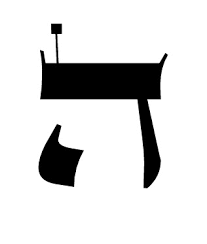
This, perhaps, is the basis of the Talmud’s assertion that it is actually by means of the letter Hey that reality comes into existence. (Menachot 29b on Gen 2:4 - punning on b’hibaram, ‘In their being created,’ the Talmud says to read it as b’ hey baram: ‘through Hey they were created’). Just as the letter Hey is open and easeful in expression, so too the Divine process of creation. Like a sigh, reality just kind of slipped out, and there all of a sudden it was, like the shoots coming out in the spring.
That the letter Hey underlies both creation and redemption relates also to the spiritual focus of this month: refining and restoring our power of speech. God, says the Jewish (amongst other) traditions, speaks the world into being. And the human, in the image of God, is known as me’daber, the Speaking One. (As opposed to minerals, which are called Silent Ones, plants, or Growing Ones, and animals, Living Ones). As Rabbi Dovber Pinson writes in his excellent Spiral of Time series on the Jewish year, “Speech implies choice, for through language we define our reality.”
Freedom of speech and self-expression in the broader public sense is where we see real-time fights to ‘control the narrative’ and thus control reality. We see all around us fascistic attempts to ban books, discredit journalists, circumscribe curricula and close down libraries. Nor is the Jewish world free from these oppressive moves. I suggest you try, for instance, saying ‘Nakba’ in mainstream Jewish space and see what happens.
Not only do we create our external realities through the ways we frame and describe them. What is more, speech is also a profound indicator of our true level of inner freedom. It is only when we can really choose how we express ourselves in every moment - ideally mindfully, gently, and effectively - that we might consider ourselves to be free of inner compulsion, the enslavements of habituation or reactivity.
The Zohar asserts that in Egypt, speech itself was in exile, and Rabbi Pinson comments that:
“This exile of speech, this inability to give voice, even to oneself, to one’s wants, needs and feelings, is the deepest exile possible. To be a human is to be a me’daber, a speaking being. When we cannot express ourselves, never mind articulate to others what we are thinking or experiencing, we are exiled from our own humanity. To take away someone’s ability to speak robs them not only of their humanity but of their capacity for meaningful relationship to other humans… We contextualize and navigate life linguistically. A slave does not have the choice to articulate or reveal who he really is, for his reality is imposed upon him.”
This, then, is why this season of redemption is celebrated through our annual feast of story-telling, Passover. The book we base the Passover Seder around is called the Haggadah, which literally means Telling and, say the sages, “Whoever expands at length [on its story, the exodus] is to be praised.”
Nor is speech, in and of itself, enough. The Seder night, which “begins with degradation and ends in praise” reaches its peak not with story-telling, but in fact with song. It is the only night of the year in which we are commanded to sing, with Hallel, the service of exultation, the high point of the night, and songs both before the food and after.
Perhaps, in the end, this is because song is a natural response to freedom, an expression of automatic joy. When we sing our mouths and our hearts are open. And, at this season of the spring, all around us the world sings out its joy. Which verse, after all, represents the acrostic of God’s right-ordered Name, the Name for this month, Y-H-V-H?
Yismechu Ha’shamayim V’tagel Ha’aretz: The heavens themselves are rejoicing, and the very earth exults. (Psalms 96:11)
Happy spring, everybody. May we yet know freedom, within and without.