Future Focus
Deuteronomy tells us more than the story thus far. It tells us how to keep writing and reading it as we go along.

As those following the cyclic annual reading of the Torah will know, we recently started its fifth and final book, Deuteronomy. This Greek name means ‘Second [telling of the] Law’ and although in Hebrew it is mostly known as Devarim, meaning ‘Matters’ or ‘Words,’ the rabbis also call it Mishne Torah, or ‘Reiterating the Teaching.’ Why this emphasis on review?
At face level, Deuteronomy represents repetition in that it is Moses’ recapitulation of the Israelites‘ story. But — and I think this is important enough to write a whole essay about — it is also here that the Torah reinforces the idea of itself as a text to be revisited and retold through the ages, an indispensable intergenerational transmission.
Now, Jews do obviously relate to the Torah as an intergenerational document. Indeed most bnai mitzva / coming of age ceremonies, at least in the liberal American context, include a ritual in which the Torah scroll is physically handed down from generation to generation, grandparents passing it to their children, and these children in turn passing it to their own child, all standing witnessed by the congregation before the open ark. Often a very meaningful moment, this physical enactment sends a message about what Torah is: a code we try both to inherit and to transmit. This is a code for living a good life, full of messages explicit and implicit about how to do so; it discusses such matters as how to thrive in community, how to relate with the earth, and how to cultivate relationship with history, identity and the divine be-ing that gods us. What better for ancestors to share with their descendants?
One could say that the Bible as a whole sets out to be an intergenerational document. Indeed, as Genesis asserts: “This is the book of the generations of humankind” (Gen 5:1) — but that said, the focus is initially more backwards in time than forwards, discussing where we have come from more than where we’re going.
Thus these early chapters feature a list of begettings, so memorable in form if not in content — with their improbably lengthy life-spans and notable absence of female participants — that the word “begat” can become a parody of biblical text. Stripped of the exoticizing of a bunch of silly names and ages, these are records of mostly unremembered humans propagating themselves over long periods of time; a record of universal history indeed.
Surrounding these are a series of mythic propositions about the origins of our form as a consciousness, and the roots of our existential condition. That these stories of a garden, a flood and an abandoned tower still hold such sway in the collective human field (whether or not we “believe in” them per se) is interesting. Of course the crucifix and the sword have done a lot to increase their global reach. But arguably the staying power of these images implies that they do indeed meet an archetypal need, the need to explain where we’ve come from as species and as civilization.
Judaism considers ‘Torah’ to encompass two forms: the written (Bible) and oral (all subsequent discussion and engagement with the texts, up to and including right now). Studying and teaching Torah is a living connection with our intellectual ancestors, and a living contribution as ancestors to the future. But, sort of astonishingly when you think about it, Jewish people who aren’t converts or the immediate descendants of converts tend to believe we’re pretty much directly descended from the characters in this book. We’re Bnei Yisrael, the children of Israel. Israel, you know, also originally called Jacob, a successful late bronze age goatherd who spent his lifetime (about 3700 years ago) feuding with his brother, going off to make his fortune, having a number of potent spiritual encounters, and doing his own good share of begetting.
For while Genesis’ opening chapters are considered to be a sort of universal Torah, for us the ‘Jewish’ story begins with Jacob’s granddaddy Abraham. Regarding the first part, the sages enumerate seven ‘Noahide’ commandments (that all descendants of Noah, i.e. everyone) are subject to: featured prohibitions include murder, incest and eating the limb of a living animal. Don’t do it! Regarding the second, as Genesis 12-25 recounts, Grandpa Abraham had a very special relationship with Creator and was told his descendants would be very many, and that through them humanity at large would be blessed. Among these descendants was Jacob-Israel, who ended up bringing his 12+ sons and daughters with him down to Egypt when a prolonged famine hit Canaan. The rest, as they say, is (pseudo-)history.
But even without the idea that anyone is the biological offspring of these canonical ancestors, the stories of their sojournings and struggles still bear existential weight.
Genesis is the tale of a family: of sibling rivalry, favoritism and rifts between parents and their children; of dislocation across place; of belief, identity, names, marriages, feuds and repair. These themes are amongst the most universal in human experience. The central characters of ‘Jewish’ Genesis cover four generations, which is roughly what human lifespans lend themselves to. (How many of us knew our great-great grandparents? Some maybe, but it’s rare. Ditto great-great-granchildren. By the way, the idea of seven generations popularly ascribed to Indigenous North American thought may actually be a misunderstanding of some version of this. The Iroquois don’t reckon seven generations into past or future, but rather seven generations spanning past and future, in which our own generation is the middle.)
Interestingly, the core of the Torah also centers around a sort of middle generation, those who neither begin the story nor complete it. Thus three of the five books discuss the lives of the people, led by siblings Moses, Aaron and Miriam, who leave The Narrow Place a.k.a. Egypt and then wander for forty years, ultimately dying in the desert. The wild and empty location is not the only existential theme here present, although it’s undeniably a rich one. Adding a layer of self-referential complexity, because Hebrew is classically written without vowels, the word for wilderness, midbar, is visually indistinguishable from the word medaber, which means ‘speaking.’ The empty unsown space of our wanderings is indeed fertile ground for a story.
Inasmuch as they never reach the promised land, and inasmuch as the persistent themes of these wilderness episodes are ones of quarrel, strife and anxiety about resources, I would suggest that this ‘middle generation’ is a representation of mature adulthood, with all its tribulations. These are tribulations probably felt more by those in peak adulthood than by the elders (the ancestral forebears discussed in Genesis) or children (the future generations foreseen in Deuteronomy) that bracket their story.
Interestingly, for a work which is generally very invested in family lineage, Moses, Miriam and Aaron don’t seem to have much relationship with either their parents or their children, and what relationship there is is marked by rupture. (Think: Moses’ mother giving him up for adoption; Aaron’s sons killed by God.) One could say that they perhaps thus stand for a sort of universal Self: unmoored from past and future, beset by the challenges of leadership and survival, wrestling with inscrutable and sometimes irascible powers, all while wandering through an existentialist no man’s land. Have I said existential enough yet? I really mean it.
Perhaps needless to say, a(n existentialist) trans-generational story necessitates the presence of death.
The book of Numbers is so called because it begins and ends with censuses, and while the tallies are similar, all the names have changed. This is because Numbers is the book in which almost everybody who left Egypt dies. This opens the way for a new generation, with new attitudes and new leaders, who may themselves make the progress their parents could not. It is worth noting, though, that the Torah ends without this happening. Modern biblical scholars think that much of Deuteronomy and of Joshua, the next book on, were written by the same folks, so the decision to split them and not end in the promised land was a conscious one. From a literary as much as a political perspective, this was - in my opinion - a very good move. Life, like Torah, tends to deny clear resolution and triumphal happy endings. Rather, like the Israelites, we die still on the threshold of arrival.
And so to Deuteronomy, the threshold oration.
Even marginally observant Jews are probably familiar with the Torah’s emphasis on “teaching this to your children” (see: the Shema) and impressing upon them the sense that we ourselves left Egypt (see: the Passover seder). What you may not know is that all of these key texts and ideas come from Deuteronomy.
Delivered as a prelude to entering the land, by a leader who knows that he too will soon die, Deuteronomy’s inevitable focus is the future. Some of this is a more or less immediate future, as instructions are given for the conquest itself, and for the society that will then be established. Probably because the authors knew that it had indeed changed over time (and might do so again), Deuteronomy never gives an exact location for “the place where God will choose for God’s name to dwell,” but the assertion that such a site will be established is repeated many times.
Along with religious and social instructions to support this shrine, Deuteronomy ordains mechanisms to address anticipated economic inequality. Thus we see instructions for cyclic redistribution of resources, as well as seasonal provision for the landless, the poor and vulnerable. It is in Deuteronomy that the Torah gains real momentum as a book about social justice.
However, Deuteronomy does more than anticipating social needs, and its focus on the future contains distinct strains of the prophetic, summoning images of generations and situations yet to come. Thus in Deuteronomy 29, Moses explicitly states that included in the audience for his address are both “those who are with us here today” and “those not [yet] here.” A few verses later, the scribal tradition literally underscores (well, actually literally overscores) the phrase “concealed matters are the province of God, but what is revealed belongs to us and to our children, forever.”
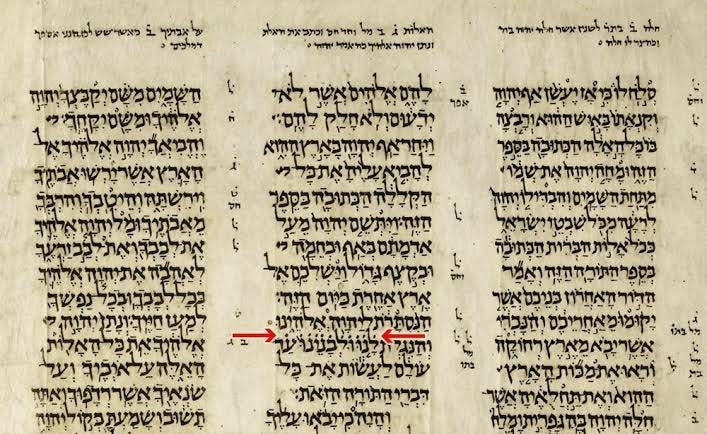
At its peak, Deuteronomy offers stirring predictions: that the Hebrews will forget their covenant and be exiled from the land, but that even so their story and their connection with God will continue. It ends with formal blessings to each of the tribes. As the passage of generations has moved, these names - Judah, Simeon and so on - have shifted from being those of individuals, to those of tribal clans, each with its composite identity, its strengths and its needs.
But as well as all this, it is also in Deuteronomy that the Torah begins to discuss itself as a formal text and indeed to use the term ‘Torah.’ As we learn in Deut 31, this teaching is something not only to be studied and discussed, but to be read in public as a regular ritual, and to be literally carried as a sacred artifact and a guide. It is to be kept in an ark, and tended by a special caste of the learned. Sound familiar? Indeed, it is in Deuteronomy that the term sefer ha’Torah (Book of the Teaching) is first used, creating a strong implicit association with our own scrolls, which are called the same thing.
Torah is a story about itself, and the way we use Torah also tells us who we think we are — participants in families, and transmitters of history, identity, migration and blessing. As we see with particular clarity in Deuteronomy, Torah means more than just a set of laws announced on a mountain. Torah is a social good, a mystery half hidden and half revealed, a physical object to be tended and carried, and a witness, a third leg supporting relationship between people and God.
The most future-facing book of the five, Deuteronomy is the most thoughtful about what a tradition needs in order to stay referenced and relevant — with or without a building, a priesthood, or a sacrificial cult.
For us, it turns out, it means being people of the book. This book.